General Description
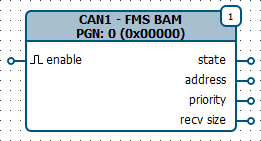
Read the announcement for the specified PGN and place the subsequent data into the RXD buffer.
The function does not send requests, but only reads the data set following the BAM message (Broadcast Announce Message) with the specified PGN.
The function uses the RXD buffer
For the function to operate, the following settings must be configured in the device configuration:
Configuration➜CAN Bus
..➜Use built-in CAN interface
¶ Graphical Representation
| In the function menu | On the diagram |
|---|---|
 |
 |
¶ Inputs
| Name | Value type | Description |
|---|---|---|
enable |
bool |
Enable data reception |
¶ Outputs
| Name | Value type | Description |
|---|---|---|
state |
int32 |
Receiver state: 0 — receiver disabled 1 — output data is not valid 2 — data received and valid 3 — receiving data 5 — settings not configured 6 — configuring settings 7 — settings configured -1 — function configured incorrectly or device resources unavailable -5 — response not supported |
address |
int32 |
Source address |
priority |
int32 |
Message priority on the bus |
recv size |
int32 |
Number of bytes received in the receive buffer |
¶ Status Transitions
0 -> 5 -> 6 -> 7 -> 1 -> 2 // final status in case of success
                         |
                         * -> -5 // response not supported

[0 .. 7] -> -1  // Transition to an error is possible from any status
¶ Settings
| Name | Description |
|---|---|
| Bus | CAN interface used |
| Timeout, ms | Timeout during which the output data remains valid |
| PGN | PGN for which the request was made |
¶ Examples
¶ Example 1
According to the FMS protocol, if there is more than one fault code, the data is transmitted in multiple packets.
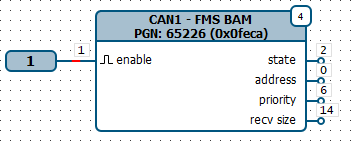
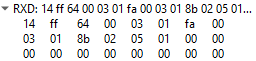
The block received 14 bytes of data: 2 bytes contain fault lamp statuses, while the remaining 12 bytes contain three fault codes, 4 bytes each.
The data was received from the module with address 0.